
“Protest?! Aren’t we going to get shot and killed?” my daughter, Ariya exclaimed, eyes wide in shock. We were about to fly into Washington DC.
“No it will be a peaceful protest AND we are not in LA,” I added.
It was Thursday and we were about to embark on a weekend trip to Washington DC.
My kids thought they were just going to see the capital of the United States. Little did they know the itinerary I had in store for them.
“What do you want?” I asked, shouting into the megaphone, pointing it to an unmarked building that housed the Vietnam Embassy on 20th Street.
“Freedom!” they yelled back in union.
“Freedom for Who?” I yelled back.
“Khmer-Krom!” yelled Mr. Chau Reap, an elder and long time KKF advisor.
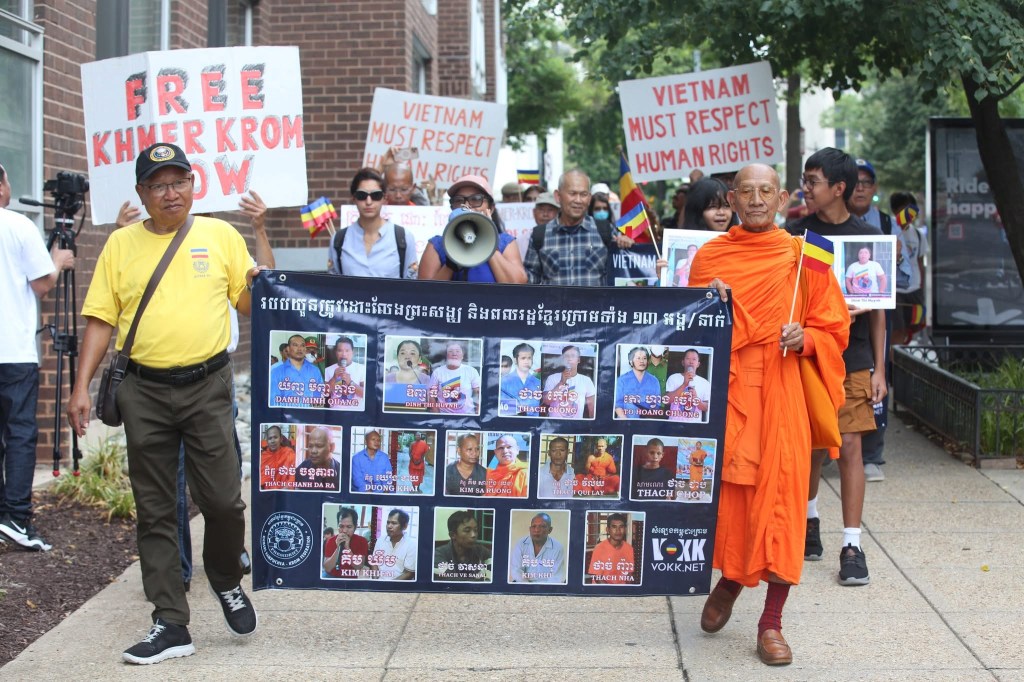
He was one of 30 thirty Khmer Krom people and Buddhist monks gathered Friday to protest for the release of Khmer-Krom activists detained by Vietnamese authorities.
Some activists were imprisoned for seeking to learn and advocate for their indigenous rights, while others were defrocked for refusing to join the State controlled Vietnam Buddhist Sangha.
“How Many Khmer-Krom? I asked.
“15!”
Across the street, four officers from the FBI stood guard, watching quietly as we paraded back and forth making as loud a racket as we could.
“When do you want it?,” I yelled.
“Now!!!”
“When do you want it?” I asked again.
“Now!!!” They roared back.
“It doesn’t make a difference,” my daughter had muttered earlier before the demonstration, in protest of her involvement.
“Sure it does, for the people behind bars.” I told her quietly.
My kids knew some of my work with the Khmer Krom. They knew I flew to the United Nations every year and recognized the colors of the Khmer Krom flag. But they didn’t know that at twenty-one, I had flown from Australia to protest right here in this very city.
It was two decades ago, and yet in that moment, it felt like just yesterday. I remember the heart-pounding roar of unity at Freedom Plaza, as hundreds of Khmer Krom and Montagnard people gathered to protest the arrival of Vietnam’s Prime Minister.
I was only a couple of years older than they are now when I joined my first protest. I had no idea what I was doing or what I was getting myself into—only that it felt right. I was searching for my Khmer identity. That search eventually led me to the Mekong Delta, to the United States, and to their father.
Longtime advocates for the Khmer Krom community, Samon Thach and Somalin Thach brought their three boys to the protest, while Serey Chau brought his daughters.
We were the first generation that had freedom, education and opportunity. We had to learn and balance new social norms whilst respecting traditions of our parents. In our search for who we are, we found each other and our purpose. One that we are keen to pass on to our children.
For us, it felt full circle.
Despite her earlier reservations, my daughter stood silently next to her brother holding the sign of four Khmer Krom activists. Mrs. Thi Dinh Huynh, one of the activists pictured was released just a couple months earlier.
It was hard to be in the heat and humidity. To yell for a couple of hours.
My kids, like a couple of other protesters used their sign to cover their faces. A couple of others sat under a small tree by the sidewalk seeking some shade.
But even as the sun glared in anger, as if to test our resolve, we remembered what we were there. We rose up for a final round, forming in a line along the street and yelled once again.
Some of the elders knew what it was like to be in a war, to be shot at and imprisoned. For Mr. Chau Reap and those who attended, the heat wasn’t hard. The yelling wasn’t hard. What was hard was thinking about the people behind bars, imprisoned simply for exercising their basic rights and freedom. Imprisoned because they wanted to self identify as Khmer Krom.
And we got the easy part. Even if it doesn’t feel like it sometimes.
Most importantly, we wanted to let our activists know that they are not alone. They may be confined within prison walls but they were not alone. Our hearts and thoughts are with them. And our voices, their voices.



 Cherteal
Leave a reply to Anonymous Cancel reply